There was a time when a government job wasn’t just a career choice — it was practically a marriage qualification. Parents didn’t ask about salary first. They asked about the pension. Back then, nobody needed to work out how much you need to retire in India — the job had already worked it out for you.
That instinct made sense. A government job came with two things nobody had to think about twice: job security, and a retirement that was already funded by someone else. You didn’t need a retirement plan. The plan was built into the job.
Most of us didn’t grow up with that safety net, and most of us haven’t replaced it with anything.
So the question becomes a personal one: how much do you need to retire in India, and how do you get there from where you are today?
Why nobody taught us this
Part of it is cultural. For generations, the Indian household has run on a simple, unspoken deal: parents raise the children, children look after the parents when the roles reverse. Retirement wasn’t something you planned for individually — it was something the family absorbed together.
Part of it is also practical. When incomes are tight, a plan for something 30 years away loses every time to a need that’s due this month.
Both of those are changing. Incomes are rising, families are smaller and more spread out, and more people want to reach their sixties without depending on anyone else’s balance sheet. The financial side of that is only half of retirement — the other half is emotional, figuring out what a life without a job looks like. But the financial half is the one that runs on deadlines, so it’s the one worth starting first.
Two questions, in order
Retirement planning feels enormous because people try to answer everything at once. It gets much smaller if you only ask two questions, in this order:
1. How much do I actually need?
2. How do I start, without it wrecking my life right now?
Most people never get past question one, because the number that comes out the other end tends to look unreasonable. Let’s look at why — and then at why it’s less unreasonable than it looks.
How much do you need to retire in India: a worked example
Meet Rohan. He’s 35, his household spends about ₹70,000 a month at today’s prices, and he wants to retire at 60 — 25 years from now — without changing his lifestyle.
To work out what Rohan needs, four inputs do all the work:
How long the money has to last. Not “how long will I live” — that’s unknowable — but a deliberately long number, because running out of money at 85 is a much worse outcome than leaving some behind at 95. Planners typically use 100 as the assumed age, simply to be safe on the side that matters.
How fast prices rise. Inflation doesn’t pause at retirement. If Rohan’s expenses are ₹70,000 a month today, they won’t be ₹70,000 a month when he’s 60 — they’ll be whatever ₹70,000 becomes after 25 years of price rises, conventionally estimated around 6% a year in India. Headline CPI has been running lower than this recently, but a long-horizon plan is usually built on a deliberately conservative assumption — and household expenses like education and healthcare tend to rise faster than the headline number.
What the retirement corpus itself earns. Once Rohan stops working, his savings don’t stop working — they keep earning a return, just usually a more conservative one, since money needed for daily expenses shouldn’t be sitting in anything too volatile.
What today’s expenses actually are. The one number Rohan already knows. Everything else is built from it.
Run those four inputs through the maths, and Rohan’s number comes out to a little over ₹10 crore by the time he turns 60. Here’s exactly what went into it, so nothing is hidden inside the number:
| Assumption | Value used for Rohan |
|---|---|
| Current age → retirement age | 35 → 60 (25 years to save) |
| Money needs to last until | Age 100 (40 years in retirement) |
| Inflation | 6% a year |
| Return while building the corpus | 10% a year |
| Return on the corpus during retirement | 8% a year |
| Today’s monthly expenses | ₹70,000 |
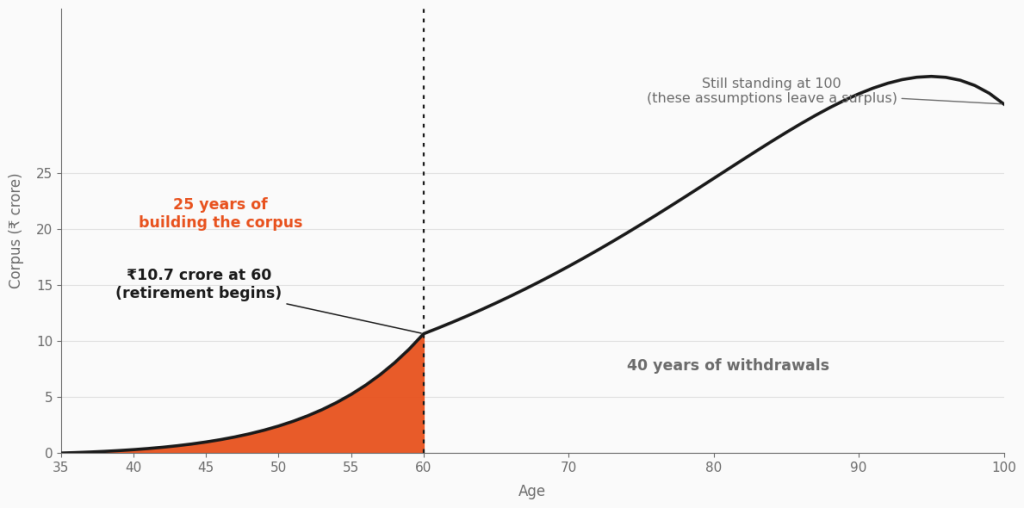
That number is not a typo, and it is not designed to scare anyone. It’s simply what ₹70,000 a month, adjusted for 25 years of inflation, and then stretched across 40 years of retirement, actually costs — for these assumptions.
This is Rohan’s number, not a universal one. There is no single figure everyone needs to retire — there’s only your figure, built from your age, your expenses, and your own assumptions about inflation and returns. Change any row in that table and ₹10 crore moves with it. The point of walking through Rohan’s example isn’t to hand you a target. It’s to show you exactly how a target gets built, so you can build your own.
The number that makes it real — and the one that makes it possible
Two ways to reach that ₹10 crore, and they produce very different monthly commitments.
Save the same amount every month, for 25 years: roughly ₹82,000 a month, assuming a 10% return along the way.
For a 35-year-old already paying rent or a home loan, school fees, and everything else life bills for — that number is where most people close the tab and stop thinking about retirement altogether.
Or, start small and increase it every year: roughly ₹33,000 a month in year one, going up by 10% annually as income (presumably) rises too.
| Year | Monthly investment |
|---|---|
| 1 | ₹32,700 |
| 2 | ₹35,970 |
| 3 | ₹39,570 |
| 5 | ₹47,880 |
| 10 | ₹77,110 |
| 15 | ₹1,24,180 |
| 20 | ₹2,00,000 |
| 25 | ₹3,22,100 |
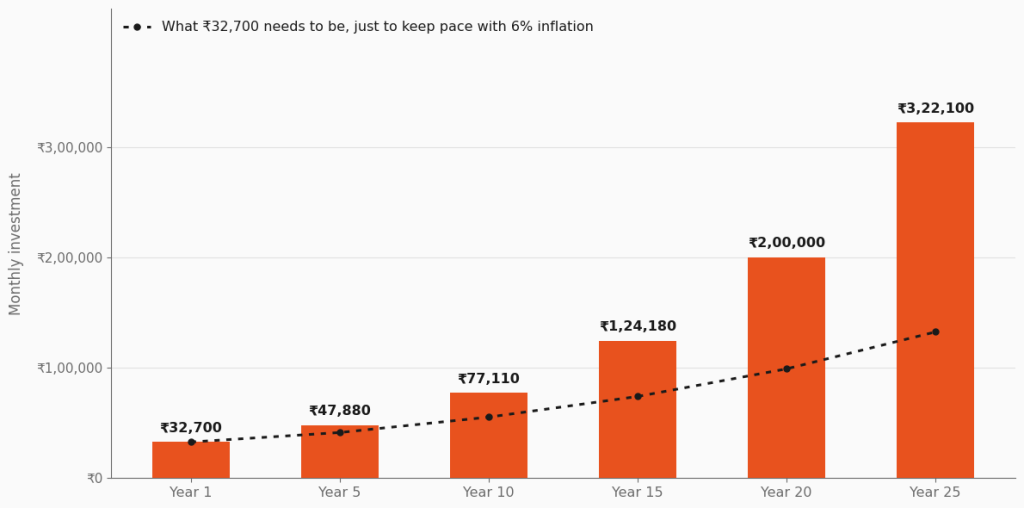
By year 25, Rohan is investing more than three lakh rupees a month — but that ₹3,22,100 is a year-25 rupee, not a today rupee. Twenty-five years of 6% inflation means that figure will feel like roughly ₹75,000 does today — not much more than his current ₹70,000 in expenses. It looks alarming next to ₹32,700 only because one number is written in today’s currency and the other is written in the currency of 2051. Once you convert them to the same year, the step-up stops looking like a trap.
The number that matters isn’t the one at the end. It’s the one at the start: ₹33,000, not ₹82,000. That’s the difference between a plan someone actually begins and a plan someone quietly abandons in month two.
Neither approach is “correct.” A flat monthly amount is simpler to automate and forces discipline early. A stepped-up amount is easier to start and assumes your income will do some of the work later. What matters is picking one and starting — the version of this plan that fails is the one that never gets past the spreadsheet.
Do your own math
Swap the values in that table for your own — your age, your expenses, your own view on inflation and returns — and the same maths hands you your number instead of Rohan’s. Nothing above the table changes; only what goes into it does.
What this number doesn’t tell you
Here’s the part most retirement calculators leave out entirely: reaching ₹10 crore by 60 is only half the problem solved.
The other half starts the day Rohan stops earning and starts withdrawing. A retirement corpus doesn’t get spent all at once — it has to keep growing while it’s being drawn down, month after month, for decades, through markets that will have good years and bad ones. Get the order of those good and bad years wrong — a market downturn in the first few years of retirement, for instance — and a corpus that looked more than sufficient on the way in can run short on the way out. This is one of the most under-discussed risks in retirement planning, and it has nothing to do with how much you saved.
Building the number is a savings problem. Making it last is a completely different problem — one of sequencing, liquidity, and knowing which part of your money needs to be safe right now versus which part still has decades to grow.
Will your retirement income actually last?
Most investors focus on building a retirement corpus. Few focus on converting that corpus into sustainable income — and that gap is exactly where sequencing risk does its damage.
The three-bucket strategy is built to close it, by giving each part of the corpus a specific job instead of leaving all of it exposed to the market at once:
Bucket 1 — Income (3–7 years of expenses): cash, liquid funds and short-term deposits. This is what actually pays the bills each month, and it never touches the stock market.
Bucket 2 — Preservation (7–10 years of expenses): debt funds and bonds, conservative enough to hold steady, and used to top up Bucket 1 as it’s drawn down.
Bucket 3 — Growth (the remaining corpus): equities and growth assets, left alone for a decade or more so they have time to recover from any downturn and keep outpacing inflation.
We built Will Your Retirement Income Last? to test exactly this — whether your corpus, split this way, actually survives the withdrawal years, or where it’s likely to run thin. Retirement planning isn’t only about the number. It’s about knowing the number will hold.
Frequently asked questions
How much money do I need to retire in India?
There’s no single figure. It depends on your current monthly expenses, your age, how long you expect the money to last, and your assumptions about inflation and returns. For someone spending ₹70,000 a month at 35 and retiring at 60, the number works out to a little over ₹10 crore.
Is ₹1 crore enough to retire in India?
For most people retiring 20–25 years from now, no. ₹1 crore at 6% inflation over 25 years buys roughly what ₹23 lakh buys today — enough for a few years of expenses, not for a 30–40 year retirement.
How much should I invest monthly to retire with ₹10 crore?
Roughly ₹82,000 a month for 25 years at a 10% return if the amount stays flat. Or about ₹33,000 a month in year one if you increase it by 10% every year as your income rises.
The two things to remember
Everything above collapses to two decisions:
Know your number. Not a guess — the one that comes from your actual expenses, your actual timeline, and honest assumptions about inflation and returns.
Start before the number feels comfortable. The version of this plan that works is the one that starts at ₹33,000, not the one that waits until ₹82,000 feels affordable.
The number will always look large from 30 years away. That’s not a reason to wait. It’s the reason to start now, while the smaller version of it is still on the table.
Disclaimer: This article is for educational purposes only and does not constitute investment advice or a recommendation to buy or sell any security. The example, figures and assumptions used are illustrative. Investments in securities market are subject to market risks; read all the related documents carefully before investing. Past performance is not indicative of future returns.
SIHO Research Pvt. Ltd. — SEBI Registered Research Analyst | Reg. No. INH000019813