Eicher Motors’ share price history holds one of the most instructive turnarounds in Indian markets. This is how it happened, what it cost in patience, and where the risks sit today.
In 2000, a 26-year-old was handed a motorcycle business that his own group was considering selling or shutting down.
The brand was selling around 2,000 motorcycles a month against a plant capable of building 6,000. The motorcycles suffered from serious reliability problems — oil leaks, engine failures, electrical faults — and were sold to a shrinking group of loyalists who tolerated the flaws out of affection. Inside the group, the motorcycle division was seen as a drain.
That 26-year-old was Siddhartha Lal. The brand was Royal Enfield, then a division of Eicher Motors.
He asked his father for time to turn it around.
What followed is the most instructive chapter in Eicher Motors’ share price history — not because the stock went up, but because of why it went up, and how visible the reasons were to anyone paying attention.
A Company That Was Good at Nothing
To understand the turnaround, you first have to understand how ordinary Eicher was.
By the early 2000s, the Eicher Group ran roughly 15 different businesses. Motorcycles. Trucks. Tractors. Automotive components. Footwear. Garments. It was a classic Indian conglomerate — spread wide, anchored nowhere.
And in not one of those 15 businesses was Eicher the market leader.
This is a pattern investors see constantly. A company present everywhere and dominant nowhere. Revenue exists, the balance sheet functions, the business survives. But there is no pricing power, no moat, and no reason for the market to pay a premium for it.
The stock was valued modestly through the late 1990s and early 2000s, trading in low single digits on a split-adjusted basis — a relatively overlooked mid-cap, given what the market would eventually come to think of the company.
The Turnaround Begins
When Lal took charge of Royal Enfield in 2000, the problem was not brand awareness. Royal Enfield had been in continuous production since 1901 and carried genuine cultural weight in India — army officers rode Bullets, and so did their sons.
The problem was that the product had stopped being good.
Reliability was poor. Defect rates were high. Supply chain inefficiencies caused constant production delays. Meanwhile, Japanese manufacturers were selling motorcycles with far better reliability and far lower maintenance demands.
Lal’s fix was unglamorous and slow: rebuild the engines, tighten quality control, upgrade assembly lines, and repair the dealer relationships that years of poor service had damaged. He brought in a dedicated client-servicing team to handle dealer complaints — a detail that sounds trivial and was not, because dealers were the only people still willing to sell the product.
None of this made headlines. It took most of a decade.
The Decision That Looked Like Madness
In January 2004, Lal became Chief Operating Officer of Eicher Motors. And in 2005 came the call that defines this entire story.
Under his leadership, Eicher sold 13 of its 15 businesses.
Everything went except two: Royal Enfield and trucks. The reasoning was simple and brutal — these were the only two where Eicher had a genuine shot at market leadership. Everywhere else, the company was destined to remain average.
Read that again in the context of what Royal Enfield was at the time. The group divested functioning businesses in order to concentrate capital behind the loss-making one.
Detractors called it foolhardy. From the outside it looked like a young heir dismantling a company his family had spent decades assembling, to fund a nostalgia project.
It became one of the most consequential capital-allocation decisions in India’s automotive industry.
One Motorcycle Changed Everything
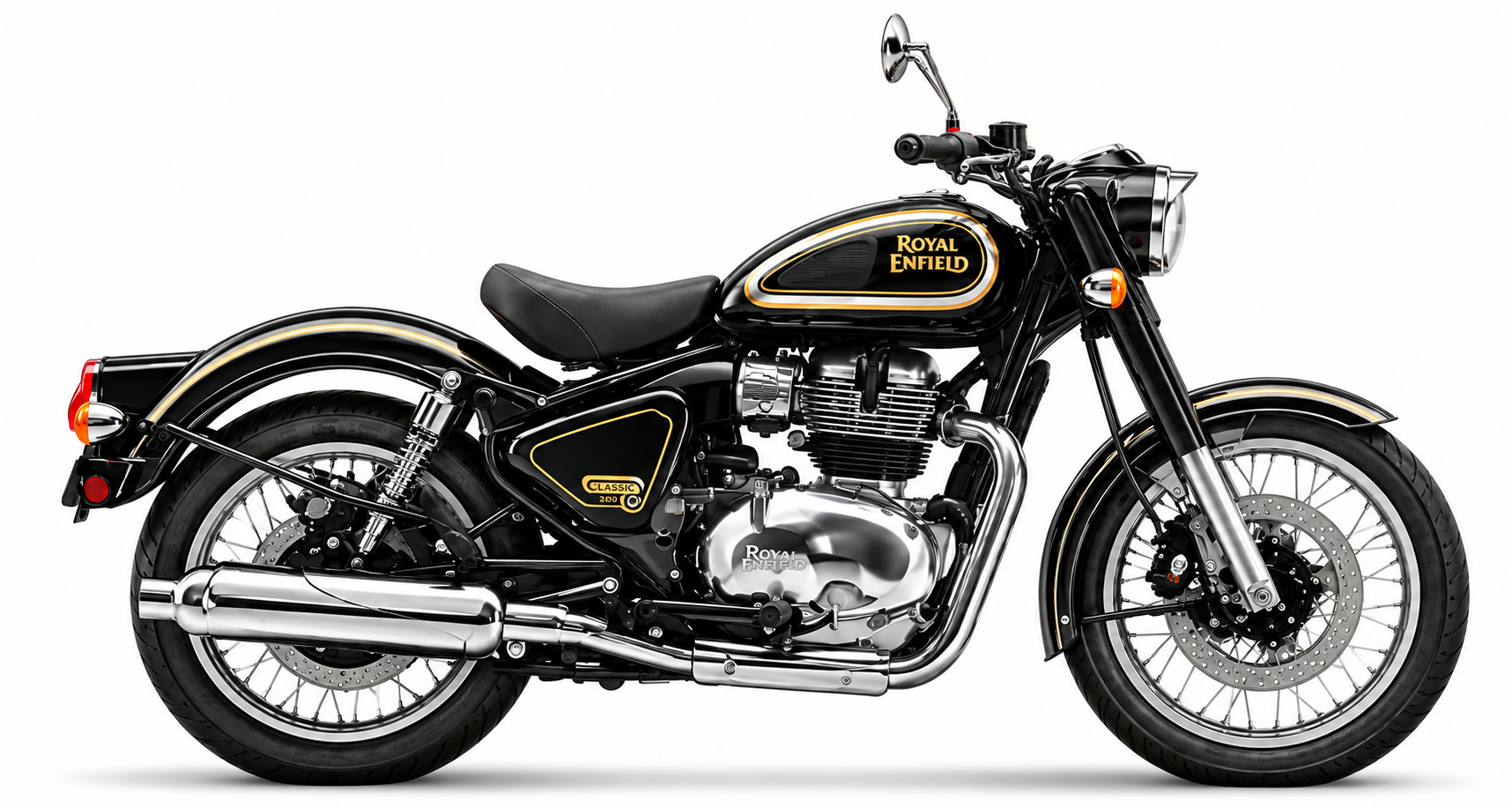
With the portfolio narrowed, capital and management attention went into product. In November 2009, Royal Enfield launched the Classic 350 alongside the Classic 500.
The product insight was precise. Rather than modernise the look, Royal Enfield kept it — a motorcycle that looked like 1955 but worked like 2009. The Classic retained the silhouette, the thump and the presence of the old Bullet, but paired them with the new unit construction engine, which was more modern, more reliable and more refined than the old cast-iron motor.
Eicher’s own investor material calls the Classic launch the inflection point. The volume history shows exactly why — and also shows something most retellings of this story leave out.
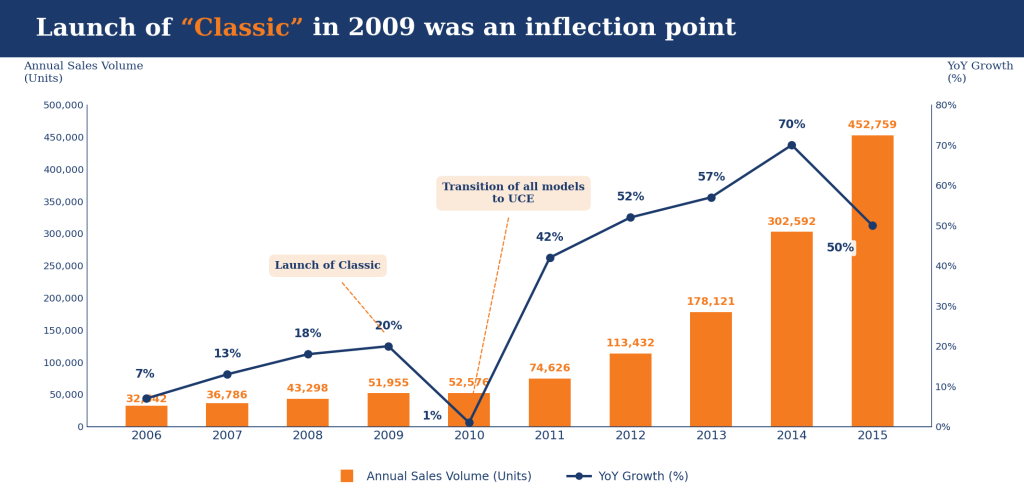
In 2009, the year the Classic launched, Royal Enfield sold 51,955 motorcycles. In 2010, it sold 52,576 — growth of just 1%, as the company transitioned its entire model range to the UCE platform.
A full year after the launch that Eicher itself calls an inflection point, the numbers had barely moved.
Then it broke open:
| Year | Units sold | YoY growth |
|---|---|---|
| 2009 | 51,955 | 20% |
| 2010 | 52,576 | 1% |
| 2011 | 74,626 | 42% |
| 2012 | 113,432 | 52% |
| 2013 | 178,121 | 57% |
| 2014 | 302,592 | 70% |
| 2015 | 452,759 | 50% |
From 32,642 motorcycles in 2006 to 452,759 in 2015 — annual volumes multiplied close to fourteen times in nine years, with the sharp acceleration beginning two years after the Classic launch.
As volumes accelerated, demand outpaced production capacity, and waiting periods became a persistent feature of the brand.
At the same time, the second surviving business was restructured. Eicher formed VE Commercial Vehicles, a joint venture with Sweden’s AB Volvo. Volvo brought manufacturing and engineering depth; Eicher brought distribution reach across India. The commercial-vehicle business subsequently became a meaningful second contributor to the group.
By 2015 the scale of the shift was clear: on the basis of first-quarter FY2015-16 results, Royal Enfield was contributing roughly 40% of Eicher Motors’ turnover and around 80% of its operating profit.
By then, the 2005 decision was looking strongly vindicated.
Eicher Motors Share Price History: The Numbers Behind the 2,090x
Here is where the story becomes a return.
On 8 February 2002, Eicher Motors traded at ₹3.68 per share on a split-adjusted basis. As of early September 2026, the stock trades at approximately ₹7,700.
That is an increase of roughly 2,090 times in the share price over about 24 and a half years — a share-price CAGR of close to 36%, excluding dividends.
₹1 lakh invested then would be worth approximately ₹21 crore as of early September 2026, based on share-price appreciation alone and before dividends, taxes and transaction costs. Eicher has paid dividends over this period, so an investor who reinvested them would have done somewhat better than this figure suggests.
A necessary clarification, because this is where most write-ups go wrong: Eicher Motors executed a 1:10 stock split with an ex-date of 24 August 2020, subdividing each ₹10 face-value share into ten ₹1 face-value shares. Every historical price quoted here is split-adjusted. Figures that ignore this adjustment — and several circulating online do — overstate returns by a factor of ten.
But the headline number matters less than when the money went in.
An investor who bought in 2002 — while Eicher was still a directionless conglomerate with a struggling motorcycle division — captured the full multiple. An investor who bought in 2012, after volumes had already doubled and the story had become obvious, captured a far smaller one on the very same business. The later the entry, the more of the re-rating had already happened.
The largest gains accrued to investors who bought before the turnaround was fully reflected in the share price. It is the same arithmetic that shaped Titan’s long-term journey — and the same reason starting early matters more than timing perfectly.
Where the Business Stands Today
The business has continued to grow strongly.
FY26 was Eicher Motors’ highest-ever annual financial performance, with revenue from operations of ₹23,408 crore, up 24% year on year. Profit after tax rose 17% to ₹5,515 crore, with EBITDA at ₹5,785 crore. The board recommended a final dividend of ₹82 per share.
Royal Enfield sold 1,227,977 motorcycles in FY26, a 22% increase — this after crossing the one-million annual mark for the first time in FY25. Set against the 51,955 units of 2009, the scale of what was built becomes clear.
Profitability has remained high, with return on capital employed of 22.61% and a balance sheet carrying low net debt. Profits have compounded at roughly 33% annually over the five years to FY26.
Capacity is being built for the next leg: an investment of up to ₹958 crore approved to expand the Cheyyar facility from 14.6 lakh to 20 lakh units a year, alongside a new greenfield plant in Andhra Pradesh and the company’s first electric motorcycle, the Flying Flea C6. This capacity is being added over time and is not yet fully operational.
The Other Side: Where the Risk Sits
A story this clean deserves an honest counterweight — and there is one.
Royal Enfield has historically held a commanding share of India’s mid-weight motorcycle segment, at times cited above 90%. That invited competition, and it arrived in force. Hero MotoCorp partnered with Harley-Davidson to launch the X440; Bajaj Auto partnered with Triumph for the Speed 400 and Scrambler 400X. Eicher Motors’ shares came under pressure around these launches, and brokerages raised concerns about market-share and earnings risk — Kotak estimated Royal Enfield’s segment share could compress towards the mid-70s in percentage terms.
Lal himself has acknowledged that a share of that magnitude would be difficult to sustain as credible competition entered the segment.
So far the moat has held better than expected. In June 2026, Royal Enfield occupied all four top positions in the 350–450cc segment, with the Classic 350 alone selling 40,660 units and commanding roughly 33% of the segment. The four models together sold approximately 98,000 units that month. Triumph’s 350 managed 4,692; the Harley X440, 1,197.
But two risks remain live. The first is valuation — with the stock trading at a price-to-earnings multiple approaching 40, a great deal of continued execution is already priced in. The second is the electric transition, which could challenge some of the sound, feel and mechanical character that currently differentiate Royal Enfield’s petrol motorcycles, even as the company builds its own electric platform.
What This Story Is Actually Teaching
The lesson here is not “you should have bought Eicher.” That lesson is useless, because it can only be learned after the fact.
The useful lessons are these:
Focus can unlock value. In Eicher’s case, the earlier portfolio had spread management attention across businesses where the group had no path to leadership. Narrowing the field released both capital and focus. This is not a universal law — diversification works where genuine synergies exist — but when management deliberately narrows its field, it is usually a signal worth examining.
Management quality is a financial variable, not a soft one. The share-price increase was ultimately supported by a series of important management and capital-allocation decisions, alongside years of execution, partnership and a growing Indian market. Read what management does with capital, not what it says in the annual report.
Good products take time to show up in the numbers. This is the single most useful thing in the volume chart above. The Classic launched in late 2009. Through all of 2010, sales grew 1%. An investor reviewing the numbers at the end of 2010 would have seen a major product launch that appeared to have changed nothing — and could reasonably have concluded that it had not worked. The 42%, 52% and 57% growth years came afterwards. Patience was not merely a virtue here; it was essential to capturing the return.
Slow, unglamorous work compounds. The transformation was built through years of operational improvement — engine quality, dealer relationships, supply chains — rather than one dramatic event.
Eicher Motors did not become a great investment because a motorcycle sold well. It became one because a management team was willing to look at fifteen mediocre businesses and let thirteen of them go — and then wait through a year in which the fix appeared not to be working.
The next such story is being written right now, in a company that currently looks unremarkable. The question worth sitting with is not which stock multiplied in the past — it is whether you would have held through 2010.
Are You Ready to Find Your Next Eicher?
Eicher was hiding in plain sight. So is the next one.
The hard part was never finding it. It was knowing what to look for, and holding through the year when the numbers said nothing was happening.
That is the thinking we teach at InvestVidhi. Book a free one-on-one call and we will walk you through how we read a business — management quality, capital allocation, and the durability of the moat — using real companies, not hypotheticals.
InvestVidhi is a service of SIHO Research Pvt. Ltd., SEBI Registered Research Analyst (INH000019813). The call is an introduction to our research approach. No stock recommendations are made on it, and no returns are promised or implied.
Frequently Asked Questions
How much would ₹1 lakh invested in Eicher Motors in 2002 be worth today?
Approximately ₹21 crore as of early September 2026, based on share-price appreciation alone and excluding dividends, taxes and transaction costs. This reflects a split-adjusted price of ₹3.68 in February 2002 against roughly ₹7,700 — an increase of about 2,090 times, or a share-price CAGR of close to 36%.
Did Eicher Motors ever split its stock?
Yes. Eicher Motors carried out a 1:10 stock split with an ex-date of 24 August 2020, subdividing each share of ₹10 face value into ten shares of ₹1 face value. All historical returns must be adjusted for this, or they will be overstated tenfold.
When was the Royal Enfield Classic 350 launched, and how did sales respond?
The Classic 350 and Classic 500 were launched in India in November 2009. Sales did not accelerate immediately — volumes grew just 1% in 2010 during the transition of the model range to the UCE platform — before rising 42% in 2011, 52% in 2012 and 57% in 2013.
Who led the Royal Enfield turnaround?
Siddhartha Lal, who became CEO of Royal Enfield in 2000 at the age of 26 and later Executive Chairman of Eicher Motors, played a central role. The defining move was the 2005 restructuring, in which Eicher divested 13 of its 15 businesses to concentrate on motorcycles and trucks.
What were Eicher Motors’ FY26 results?
Its highest-ever annual performance: revenue of ₹23,408 crore (up 24%), profit after tax of ₹5,515 crore (up 17%) and EBITDA of ₹5,785 crore. Royal Enfield sold 1,227,977 motorcycles during the year.
What are the main risks facing Eicher Motors today?
Rising competition in the mid-size segment from Harley-Davidson and Triumph, a valuation approaching 40 times earnings that prices in strong execution, and the electric transition, which could challenge attributes central to Royal Enfield’s current appeal.
Disclosures and Disclaimer
SIHO Research Pvt. Ltd. is a Research Analyst registered with the Securities and Exchange Board of India (SEBI Registration No. INH000019813).
This article is published solely for educational and informational purposes. It is a historical case study of a company’s business evolution and past share price movement. It does not constitute a recommendation, offer or solicitation to buy or sell any security, and should not be construed as investment advice.
Eicher Motors Limited is referenced here as an illustrative example of long-term business transformation. No target price, rating or recommendation is expressed or implied. Past performance is not indicative of, and offers no guarantee of, future returns.
All share prices are split-adjusted and stated as of the dates mentioned. Return figures reflect share-price appreciation only and exclude dividends, taxes and transaction costs. Sales volume data for 2006–2015 is sourced from an Eicher Motors investor presentation; the chart has been redrawn by SIHO Research.
The analyst and/or their relatives do not hold any position in the securities discussed in this article.
Investments in securities markets are subject to market risks. Read all related documents carefully before investing. Registration granted by SEBI and certification from NISM in no way guarantee the performance of the intermediary or provide any assurance of returns to investors.
SIHO Research Pvt. Ltd. — SEBI Registered Research Analyst | Reg. No. INH000019813